When I wrote about GPT-6 Astra, the interesting question was: Can an agent take a messy problem, investigate it, and hand back something worth reviewing? The examples were deliberately substantial: bug investigations, BI recommendations, template-based reports, approval-gated record updates, and long-document synthesis. Now there is a different question: Can you afford to do that every […]
Tag: Azure AI
In my Claude Opus 5.5 for C# developers post I called Opus 5.5 from my own code: the Anthropic.Foundry SDK, Entra ID, and the effort parameter. This time the code calling Opus 5.5 isn’t mine. It’s Claude Code, running in my terminal and in VS Code, pointed at my Foundry resource. Microsoft already has a […]
Anthropic’s newest model, Claude Opus 5.5, just landed — meaning if you’re already building with Claude, you can call Anthropic’s most capable coding-and-reasoning model with a resource API key. Here’s what’s actually new, and how it looks from C#. What Actually Shipped A few facts worth knowing before you touch any code: 40% cheaper than […]
Every time a new image model ships, I ask the same unglamorous question: can I actually put this in a pipeline, or is it just good at one pretty hero shot? Most image models nail the demo and fall apart the moment you need the fiftieth consistent variant of the same product, or a single […]
The next era of enterprise AI isn’t going to be defined by chat experiences. It’s going to be defined by how well a model can actually work for you — not just talk at you. GPT-6 Astra, OpenAI’s newest frontier model, is now generally available for all customers in Microsoft Foundry. Instead of optimizing for […]
Grok 4.6 — SpaceXAI’s latest frontier model — just landed in public preview in Microsoft Foundry as an Azure Direct Model. The headline isn’t “another big model dropped.” It’s that Grok 4.6 is built specifically for long-horizon, agentic work: planning across many steps, calling tools reliably, recovering when something goes wrong, and handing you a […]
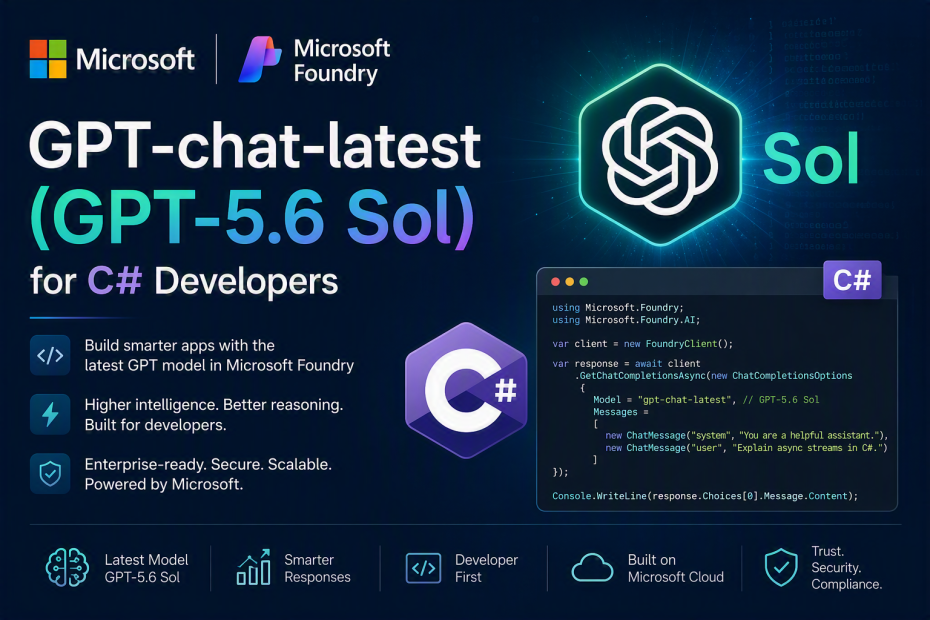
Microsoft has a habit of quietly upgrading the model behind a stable endpoint name instead of forcing everyone to migrate to a new one. That’s exactly what just happened with GPT-chat-latest — it’s now built on GPT-5.6 Sol, and if you’re already pointing at GPT-chat-latest in Microsoft Foundry, you get the upgrade without touching a […]
Every time Microsoft ships a new model into Foundry, I ask myself the same boring-but-important question: does this change anything for the way I actually write code? Most of the time the answer is “cool demo, doesn’t affect my day job.” This time it’s different. MAI-Thinking-1 — Microsoft’s first reasoning model — just went into […]
Every voice application I’ve ever built or reviewed has the same problem: latency. The model can sound as natural as you want, but if there’s a full second of dead air between the user finishing a sentence and the assistant responding, the whole thing feels broken. Users notice a pause before they notice voice quality. […]
Every time a new image model ships, my first question isn’t “how pretty are the demo images.” It’s “can I actually put this in a pipeline and get consistent, controllable output.” Most image models are great at one beautiful hero shot and terrible at the boring part — generating twelve consistent product variants, or fixing […]