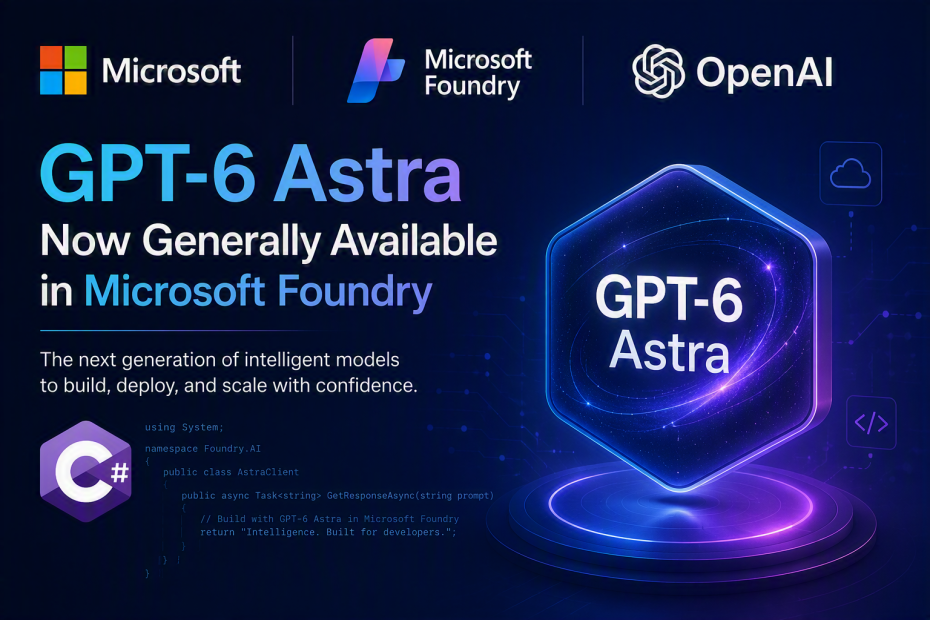
The next era of enterprise AI isn’t going to be defined by chat experiences. It’s going to be defined by how well a model can actually work for you — not just talk at you. GPT-6 Astra, OpenAI’s newest frontier model, is now generally available for all customers in Microsoft Foundry. Instead of optimizing for “answer this one prompt well,” Astra is built to take an open-ended challenge, reason through it in multiple steps, create a plan, and hand you a finished result.
That’s a meaningfully different design target, and it’s the kind of thing that matters once you move past demos and start building agents that have to survive contact with real workloads — where the interesting part isn’t the model call, it’s everything Foundry brings around it: identity, networking, governance, data handling, evaluation, compliance.
As always: no Python required, no notebook required. Just Microsoft.Extensions.AI and dotnet run.
What GPT-6 Astra Actually Is
A few things worth knowing before you touch any code:
- Deliberate planning and decision support. Astra breaks a challenge into steps, evaluates options, communicates its recommendation, and identifies next actions for review — rather than just returning a single best-effort answer.
- Polished, purposeful output. It applies context, templates, and quality standards throughout a workflow, aiming to produce documents, spreadsheets, presentations, and analyses that are ready for expert review, not rough drafts.
- Execution across applications. With advanced tool use and computer use, Astra can interact with software on a person’s behalf, move between apps, and complete multi-step tasks with appropriate human oversight — including workflows that have no dedicated API.
- Long-context understanding. Up to 1,050,000 total context tokens, so large repositories, filings, and multi-document knowledge bases can be reasoned about in one pass instead of chunked and reassembled.
- Enterprise controls by default. Microsoft Entra identity and access management, encryption in transit and at rest, private networking, RBAC, content filtering, safety evaluations, and monitoring. Prompts and outputs are not used to train the models.
- Generally available. Not preview — this is production-ready in Foundry today.
Why This Matters for .NET Developers Specifically
The enterprise scenarios Microsoft is calling out map directly onto real .NET workloads:
- Software engineering — reproduce complex bugs, investigate likely causes, propose fixes, and prepare changes for developer testing and review
- Business intelligence — build and refine dashboards in Power BI, compare data, identify trade-offs, and prepare insights to share
- Professional work — produce documents, spreadsheets, and presentations that follow existing templates and business standards
- Application workflows — update customer records, process forms, test websites, and work through approved interfaces where dedicated APIs are limited
- Financial services — synthesize filings, market data, and internal research into an investment point of view, then draft client-ready materials in a firm’s house style
- Customer experience — resolve tickets rather than route them: research the issue, act in CRM and billing, close the loop
And because Astra is a native OpenAI model in Foundry — not a partner/MaaS model — it slots in through the exact same AzureOpenAIClient + IChatClient pattern you already use for GPT-4o or GPT-chat-latest. No special client, no bearer-token workaround. Swapping Astra into your evaluation pipeline is a deployment-name change, not a rewrite.
Getting Started
|
1 2 3 4 5 6 7 8 9 10 |
dotnet new console -n GptSixAstraDemo cd GptSixAstraDemo dotnet add package Azure.AI.OpenAI dotnet add package Microsoft.Extensions.AI dotnet add package Azure.Identity dotnet add package Microsoft.Extensions.Configuration.UserSecrets dotnet add package Microsoft.Extensions.Configuration.EnvironmentVariables dotnet add package Microsoft.Extensions.AI.OpenAI dotnet user-secrets init dotnet user-secrets set "AZURE_AI_ENDPOINT" "https://your-resource.services.ai.azure.com" |
Deploy gpt-6-astra from the Foundry Model Catalog to your project — same process as any other model. Grab your endpoint and deployment name, and you’re ready to go.
Use Case 1: Software Engineering — Deliberate Bug Investigation and Fix Proposal
This is the headline scenario: Astra reproducing a complex bug, investigating likely causes, and proposing a fix for developer review — not guessing from a stack trace alone. Let’s build a small agent that pulls recent error logs and the relevant code change history before it commits to a root cause, reasoning through both signals together instead of pattern-matching on the first plausible explanation.
|
1 2 3 4 5 6 7 8 9 10 11 12 13 14 15 16 17 18 19 20 21 22 23 24 25 26 27 28 29 30 31 32 33 34 35 36 37 38 39 40 41 42 43 44 45 46 47 48 49 50 51 52 53 54 55 56 57 58 59 60 61 62 63 64 65 66 67 68 69 70 71 72 73 74 75 76 77 78 79 80 81 82 |
#pragma warning disable OPENAI001 // Responses API is experimental in the OpenAI .NET SDK using Azure.Identity; using Microsoft.Extensions.AI; using Microsoft.Extensions.Configuration; using OpenAI.Responses; using System.ClientModel.Primitives; using System.ComponentModel; var config = new ConfigurationBuilder() .AddUserSecrets<Program>() .AddEnvironmentVariables() .Build(); var deploymentName = config["AZURE_OPENAI_DEPLOYMENT"] ?? "gpt-6-astra"; var resourceEndpoint = config["AZURE_AI_ENDPOINT"] ?? throw new InvalidOperationException( "AZURE_AI_ENDPOINT is not set. Run: dotnet user-secrets set \"AZURE_AI_ENDPOINT\" \"<your-endpoint>\""); // The Responses API is only reachable on the v1 surface, not the deployments/api-version surface. var responsesEndpoint = new Uri($"{resourceEndpoint.TrimEnd('/')}/openai/v1"); var tokenPolicy = new BearerTokenPolicy(new DefaultAzureCredential(), "https://ai.azure.com/.default"); // gpt-6-astra doesn't allow tools + reasoning_effort on /chat/completions; use /responses instead. IChatClient chatClient = new ResponsesClient( authenticationPolicy: tokenPolicy, options: new ResponsesClientOptions { Endpoint = responsesEndpoint }) .AsIChatClient(deploymentName) .AsBuilder() .UseFunctionInvocation() .Build(); var chatOptions = new ChatOptions { Tools = [ AIFunctionFactory.Create(GetRecentErrorLogs), AIFunctionFactory.Create(GetRecentCommits) ], // Deep, multi-step decision support - worth paying for higher reasoning effort. AdditionalProperties = new AdditionalPropertiesDictionary { ["reasoning_effort"] = "high" // low | medium | high } }; var messages = new List<ChatMessage> { new(ChatRole.System, "You are a senior engineer investigating a production bug. Pull both recent error " + "logs and recent commit history before concluding a root cause. State your recommended " + "fix, your confidence level, and the next action a human reviewer should take."), new(ChatRole.User, "Users report 'checkout-api' intermittently returns HTTP 500 on order submission since this morning. What's going on and what should we do?") }; var response = await chatClient.GetResponseAsync(messages, chatOptions); Console.WriteLine(response.Text); // --- Tool stand-ins for real observability/source-control APIs --- [Description("Gets recent error log entries for a named service.")] static string GetRecentErrorLogs( [Description("The service name, e.g. checkout-api")] string serviceName) { return serviceName switch { "checkout-api" => "09:14 NullReferenceException at OrderTotalCalculator.Apply(discount). " + "Occurs on ~8% of requests, only when a promo code is present.", _ => "No recent errors found." }; } [Description("Gets a summary of recent commits merged to a named service's main branch.")] static string GetRecentCommits( [Description("The service name, e.g. checkout-api")] string serviceName) { return serviceName switch { "checkout-api" => "06:40 - 'Refactor discount pipeline to support stacked promo codes' " + "(touches OrderTotalCalculator.cs, PromoCodeResolver.cs).", _ => "No recent commits found." }; } |
Case 1 – Output
|
1 2 3 4 5 6 7 8 9 10 11 12 13 14 15 16 |
**Likely cause:** a regression in promo-code handling from the discount-pipeline refactor merged at **06:40**. Evidence: - Recent logs show a **`NullReferenceException` at `OrderTotalCalculator.Apply(discount)`** at 09:14, affecting roughly **8% of requests**, only when a promo code is present. - The refactor, “support stacked promo codes,” changed both `OrderTotalCalculator.cs` and `PromoCodeResolver.cs`, directly overlapping the failing path. This suggests the new pipeline permits a null value that the calculator does not handle. The exact null reference—and whether that commit was deployed before failures began—still needs confirmation. **Recommended fix** - **Mitigate:** if deployment timing confirms the correlation, roll back the refactor through the normal incident process, provided rollback is safe. - **Patch:** inspect the resolver-to-calculator contract and explicitly handle absent or invalid discount results according to intended promo behavior. Don’t simply swallow the exception or silently charge an undiscounted total. - Add regression tests for invalid, expired, unresolved, and stacked promo codes, plus orders without promos. **Confidence:** high that the failure is in promo discount handling; moderate that this specific commit caused it until deployment history and the diff are verified. **Next human action:** have the on-call reviewer confirm when the 06:40 commit reached production and review the two changed files against the exception stack. If confirmed and safe, approve rollback, then monitor checkout 500 rates and promo-order success. Before retrying affected orders, verify whether failed requests created any orders or payments. |
Notice Astra doesn’t stop at “here’s an exception” — it correlates the error with why it started happening (a specific recent change), proposes a concrete fix, states its confidence, and hands off a clear next action. That’s the “planning and decision support” Microsoft is describing, applied to something every .NET team actually deals with.
Use Case 2: Business Intelligence — Power BI Insight Synthesis
The second headline scenario is business intelligence: comparing data, identifying trade-offs, and preparing insights someone can act on. Here’s a pattern for feeding Astra a dataset summary — the kind of thing you’d pull from a Power BI dataset via the REST API — and getting back a structured, decision-ready recommendation instead of a paragraph you have to re-read three times.
|
1 2 3 4 5 6 7 8 9 10 11 12 13 14 15 16 17 18 19 20 21 22 23 24 25 26 27 28 29 30 31 32 33 34 35 36 |
using System.Text.Json.Serialization; var chatOptionsBI = new ChatOptions { ResponseFormat = ChatResponseFormat.ForJsonSchema<RegionalInsight>() }; var biMessages = new List<ChatMessage> { new(ChatRole.System, "You are a BI analyst. Given quarterly regional sales data, identify the clearest " + "trade-off, recommend one action, and flag anything that needs a human to verify " + "before it goes in a report."), new(ChatRole.User, """ Q3 regional sales summary (vs. Q2): - West: revenue +18%, returns +22%, avg order value flat - East: revenue +4%, returns -3%, avg order value +11% - Central: revenue -6%, returns +2%, avg order value -9% What should we highlight to leadership, and what's the trade-off? """) }; var biResponse = await chatClient.GetResponseAsync<RegionalInsight>(biMessages, chatOptionsBI); var insight = biResponse.Result; Console.WriteLine("Case 2: Business Intelligence — Power BI Insight Synthesis"); Console.WriteLine("**********************************************************"); Console.WriteLine($"Headline: {insight.Headline}"); Console.WriteLine($"Trade-off: {insight.TradeOff}"); Console.WriteLine($"Recommended action: {insight.RecommendedAction}"); Console.WriteLine($"Needs human verification: {insight.NeedsVerification}"); Console.WriteLine("**********************************************************"); record RegionalInsight( [property: JsonPropertyName("headline")] string Headline, [property: JsonPropertyName("trade_off")] string TradeOff, [property: JsonPropertyName("recommended_action")] string RecommendedAction, [property: JsonPropertyName("needs_verification")] string NeedsVerification); |
Case 2 – Output
|
1 2 3 4 |
Headline: West leads revenue growth (+18%), but rising returns warrant scrutiny. East shows more balanced improvement; Central is weakening across all three metrics. Trade-off: West’s strong revenue growth comes alongside a larger percentage increase in returns (+22%), with average order value flat—potentially offsetting some growth benefits. East grows more slowly (+4%) but combines fewer returns (-3%) with higher average order value (+11%). Profitability cannot be determined from these figures alone. Recommended action: Prioritize a review of West’s return drivers by product and channel before committing additional growth investment. Needs human verification: Confirm whether returns means count, dollar value, or return rate; whether revenue is gross or net of returns; and the underlying Q2/Q3 totals. A 22% increase in returns versus 18% revenue growth does not by itself establish a higher return rate or lower profit. Check return timing and seasonal effects before attributing the changes to Q3 performance. |
That last field is doing real work: Astra is explicit about where the data runs out and a human needs to step in, instead of confidently inventing a root cause it can’t actually support. Wire the structured fields straight into a Power BI custom visual, a Teams card, or an email digest — no regex-parsing a paragraph to extract “what do I actually do with this.”
Use Case 3: Professional Work — Template-Based Report Generation
The third scenario: producing documents that follow existing templates and business standards, polished enough for expert review rather than a rough draft. Here’s Astra generating a weekly status report against a fixed template structure — the kind of thing that normally eats twenty minutes of a project lead’s Friday afternoon.
|
1 2 3 4 5 6 7 8 9 10 11 12 13 14 15 16 17 18 19 |
var reportMessages = new List<ChatMessage> { new(ChatRole.System, """ You produce weekly status reports for a project template with exactly these sections, in this order: Summary, Progress This Week, Risks, Next Week. Keep tone professional and concise. Do not invent details not provided. """), new(ChatRole.User, """ Project: Order Fulfillment Modernization Raw notes from the team: - Migrated inventory sync job to the new event bus, passed load testing - Warehouse API integration is 2 days behind schedule due to a vendor sandbox outage - Next week: finish warehouse API integration, start UAT with ops team - Risk: vendor sandbox reliability could delay UAT start if it recurs """) }; var reportResponse = await chatClient.GetResponseAsync(reportMessages); Console.WriteLine(reportResponse.Text); |
Case 3 – Output
|
1 2 3 4 5 6 7 8 9 10 11 12 13 |
## Summary Order Fulfillment Modernization progressed with the inventory sync migration completed and load testing passed. Warehouse API integration is two days behind schedule. ## Progress This Week - Migrated the inventory sync job to the new event bus and passed load testing. - Warehouse API integration fell two days behind schedule due to a vendor sandbox outage. ## Risks - Recurring vendor sandbox outages could delay the start of UAT. ## Next Week - Finish warehouse API integration. - Start UAT with the operations team. |
This is deliberately unglamorous, and that’s the point — Astra didn’t editorialize, didn’t invent a risk that wasn’t in the notes, and stuck to the exact template structure. That’s the difference between “ready for expert review” and “needs to be rewritten before anyone sees it.”
Use Case 4: Application Workflows — Acting Through Approved Interfaces
The fourth scenario is the one without a clean API: updating customer records, processing forms, and working through approved interfaces where a dedicated API is limited or doesn’t exist. Full computer-use automation is a Foundry-side capability with its own configuration, approvals, and monitoring — but the same tool-driven pattern applies at the code level. Here’s Astra deciding what action to take and why, with the actual system interaction going through a scoped, human-approved tool rather than the model touching anything directly.
|
1 2 3 4 5 6 7 8 9 10 11 12 13 14 15 16 17 18 19 20 21 22 23 24 25 26 27 28 29 30 31 32 33 34 35 36 37 38 39 40 41 42 |
var workflowChatOptions = new ChatOptions { Tools = [ AIFunctionFactory.Create(LookUpCustomerRecord), AIFunctionFactory.Create(ProposeRecordUpdate) ] }; var workflowMessages = new List<ChatMessage> { new(ChatRole.System, "You process customer update requests submitted via a support form. Look up the " + "current record before proposing any change. Never apply an update directly - " + "only propose it for a human approver to confirm."), new(ChatRole.User, "Form submission: customer ACC-4471 says their billing email should now be finance@northwind-retail.com instead of the old one.") }; var workflowResponse = await chatClient.GetResponseAsync(workflowMessages, workflowChatOptions); Console.WriteLine(workflowResponse.Text); // --- Scoped tool stand-ins - the model proposes, a human/approved system applies --- [Description("Looks up a customer record by account ID.")] static string LookUpCustomerRecord( [Description("The account ID, e.g. ACC-4471")] string accountId) { return accountId switch { "ACC-4471" => "Account: Northwind Retail. Current billing email: billing-old@northwind-retail.com. Status: active.", _ => "Account not found." }; } [Description("Proposes a record update for human approval. Does not apply the change.")] static string ProposeRecordUpdate( [Description("The account ID")] string accountId, [Description("The field to change")] string field, [Description("The new value")] string newValue) { return $"Proposed update queued for approval: {accountId} / {field} -> {newValue}. Awaiting reviewer confirmation."; } |
Case 4 – Output
|
1 2 3 4 5 |
Proposed billing email change for **Northwind Retail (ACC-4471)**: - **Current:** billing-old@northwind-retail.com - **Proposed:** finance@northwind-retail.com The proposal is queued for human approval. No change has been applied. |
That “propose, don’t apply” boundary is the whole game here. The announcement is explicit about this: computer-use capability demands containment, with scoped credentials, approved resources, and human checkpoints for consequential actions. Your AIFunction tools are exactly where you enforce that boundary in code — a lookup tool that reads, and a propose tool that never writes without a human in the loop.
Use Case 5: Financial Services — Long-Context Synthesis Into an Investment Point of View
The fifth scenario leans on Astra’s up-to-1M-token context: synthesizing filings, market data, and internal research into a point of view, then drafting client-ready materials in a firm’s house style. You don’t need a chunking/retrieval pipeline for a single filing plus a research note — just pass the whole thing in.
|
1 2 3 4 5 6 7 8 9 10 11 12 13 14 15 16 17 18 19 20 21 22 23 |
var filingExcerpt = await File.ReadAllTextAsync("northwind-q3-10q-excerpt.txt"); var researchNote = await File.ReadAllTextAsync("internal-analyst-note.txt"); var financeMessages = new List<ChatMessage> { new(ChatRole.System, "You are a financial analyst assistant. Synthesize the filing excerpt and internal " + "note into a one-page investment point of view, in the firm's house style: " + "Thesis, Supporting Evidence, Risks, Recommendation. Cite which source each point " + "came from (filing or internal note)."), new(ChatRole.User, $""" FILING EXCERPT: {filingExcerpt} INTERNAL ANALYST NOTE: {researchNote} Draft the point of view. """) }; var financeResponse = await chatClient.GetResponseAsync(financeMessages); Console.WriteLine(financeResponse.Text); |
Case 5 – Output
|
1 2 3 4 5 6 7 8 9 10 11 12 13 14 15 16 17 18 19 20 21 |
## Northwind | Q3 Investment Point of View ### Thesis **Operational execution is improving, but the durability and cash returns of those improvements remain unproven.** Sales growth, better inventory productivity, and lower fulfillment costs support a constructive operating outlook. Internal checks corroborate several efficiency gains, but heavier promotions, elevated shrink, and rising automation spending temper confidence that recent margin improvement will persist. **[Filing; Internal note]** ### Supporting Evidence - **Growth is supported by both existing stores and digital demand.** Q3 net sales rose 6.8% to $1.84billion, including 3.1% comparable-store growth. E-commerce grew 14% to 27% of revenue, while fulfillment cost per order fell 8%. Field checks independently corroborate lower last-mile costs and continued strong online order growth. **[Filing; Internal note]** - **Efficiency gains extend across merchandise and operating expenses.** Gross margin increased 90 basis points to 35.7%, reflecting lower freight costs, fewer markdowns, and favorable mix. SG&A declinedto 24.1% of sales from 24.8%. Internal observations support productivity benefits from labor scheduling and reduced manual handling through distribution-center automation. **[Filing; Internal note]** - **Inventory and supplier execution are stronger.** Inventory rose just 2.4%, below sales growth, and turns improved to 4.6 from 4.2. On-time, in-full supplier deliveries increased to 93% from 88%. Store visits and supplier conversations corroborate better availability at high-volume locations and fewerexpedited replenishment requests. **[Filing; Internal note]** - **Cash generation improved, although investment demands are rising.** Operating cash flow increasedto $198 million from $141 million. Separately, year-to-date capital expenditures rose to $126 millionfrom $82 million, making investment discipline increasingly important to the cash-flow outlook. **[Filing]** ### Risks - **Margin gains face emerging pressure.** Analysts observed heavier late-Q3 promotions in discretionary categories, challenging the sustainability of the filing’s markdown benefit. Shrink increased to 1.8% of sales from 1.6%, with urban-market checks indicating continued losses despite additional prevention measures. Hourly wages rose 4.5%, creating expense pressure if sales moderate. **[Filing; Internal note]** - **Automation benefits lack a clear spending boundary.** Quarterly supply-chain automation capex reached $74 million versus $49 million a year earlier, its third consecutive quarterly increase. No capexceiling is disclosed; internal analysts flag the timing of returns as increasingly important. Continued spending could constrain free cash flow if savings or working-capital benefits disappoint. **[Filing; Internal note]** - **Expansion and seasonal inventory introduce execution risk.** Northwind opened 12 stores and closed five, ending Q3 with 486 locations. Internal checks suggest healthy new-store traffic but corroborate below-mature-store productivity. Earlier holiday inventory arrivals reduce near-term stockout risk while increasing markdown exposure if demand falls short. **[Filing; Internal note]** - **Digital cost savings are not yet a service differentiator.** Customer sentiment on delivery speedhas not materially improved, and returns remain a meaningful fulfillment expense. These findings temper the investment case for continued digital efficiency gains. **[Internal note]** ### Recommendation **Maintain a cautiously constructive operating view; require further evidence before adopting a stronger investment stance.** Prioritize holiday comparable-store growth and markdown performance, shrink stabilization, new-store productivity, and clearer automation spending limits and payback milestones. These measures will help establish whether current efficiencies translate into durable earnings and free cash flow. **[Analyst assessment based on Filing; Internal note]** A valuation-based buy or sell recommendation is not supported by the supplied materials, which provide no share price, valuation multiples, or earnings outlook. |
Every claim is tagged with its source — that per-claim citation discipline is exactly what you want before anything with “investment” in the name goes in front of a client, and it’s a direct product of feeding Astra the full source material instead of a lossy summary of it.
Where This Fits (and Where It Doesn’t)
Reach for GPT-6 Astra when:
- You need deliberate, multi-step planning and decision support — not a one-shot answer
- The output needs to be polished enough for expert review: documents, reports, structured recommendations
- You’re automating work through approved interfaces or systems without a clean API, with human checkpoints on consequential actions
- Your scenario genuinely needs long-context reasoning across large documents, filings, or repositories
Don’t reach for it when:
- You need a lightweight, low-latency conversational bot — that’s a better fit for a chat-tuned model like GPT-chat-latest
- The task is narrow, single-shot classification or extraction with no planning component
- You’re not ready to build the governance layer (approvals, scoped credentials, monitoring) that responsible agentic/computer-use workflows require — Foundry gives you the tools, but you still have to configure and own that boundary
Wrapping Up
GPT-6 Astra’s pitch isn’t “smarter chat” — it’s “does more of the actual work and hands you something finished.” For .NET developers, that shows up as agents that investigate before they conclude, reports that follow your template without babysitting, and workflows that act through your systems with a human still holding the approval button. Pair it with Foundry Agent Service so that autonomy inherits identity, security, and lifecycle management rather than becoming its own liability — and it’s worth deploying gpt-6-astra next to whatever you’re running today and comparing the two side by side.
Resources
- Source Code: https://github.com/taswar/GptSixAstraDemo
- Astra Azure Blog
- Model catalog
Building AI features in C#? I write about practical, no-hype prompt engineering and Azure AI patterns for .NET developers. Check out Prompt Engineering for .NET Developers — free, no Python required. Also subscribe to my mailing list for the latest blogs, tips and tricks I share.

Leave A Comment