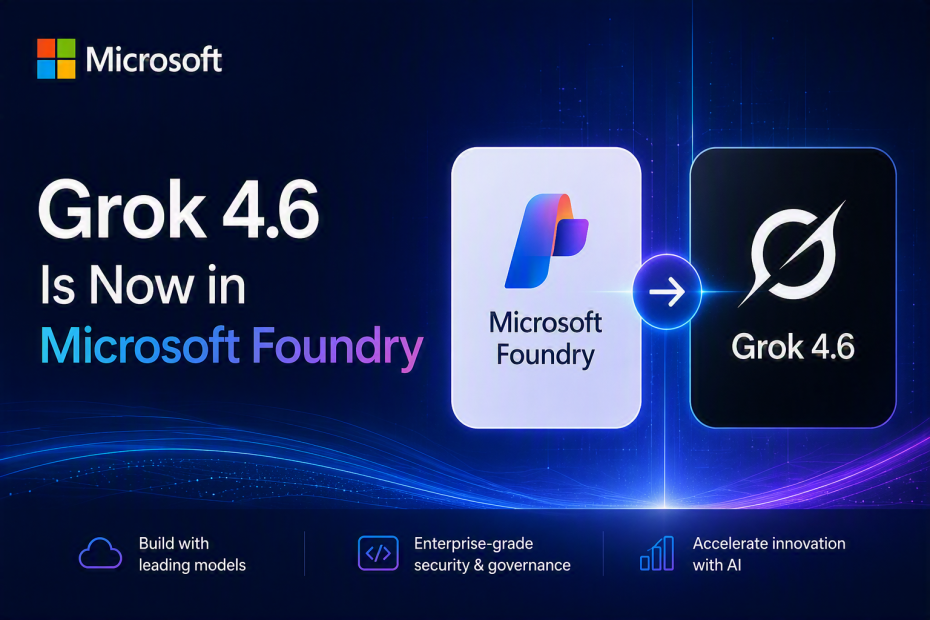
Grok 4.6 — SpaceXAI’s latest frontier model — just landed in public preview in Microsoft Foundry as an Azure Direct Model. The headline isn’t “another big model dropped.” It’s that Grok 4.6 is built specifically for long-horizon, agentic work: planning across many steps, calling tools reliably, recovering when something goes wrong, and handing you a finished work product instead of a half-baked fragment you have to stitch together yourself.
That’s a meaningfully different design target than “answer this one prompt well.” And it’s exactly the kind of thing that matters once you move past demos and start building agents that actually have to survive contact with real workloads.
As always: no Python required, no notebook required. Just Microsoft.Extensions.AI and dotnet run.
What Grok 4.6 Actually Is
A few things worth knowing before you touch any code:
- Frontier reasoning at value pricing. Grok 4.6 is positioned as the value-tier frontier option — frontier-class reasoning at a materially lower cost per task than comparable models. That matters the moment “reasoning agent” stops being a one-off demo and becomes something running continuously in production.
- Selectable reasoning effort. You choose reasoning depth per call — low, medium, high, or xhigh (default high) — instead of paying maximum-reasoning cost on every single request regardless of whether the task needs it.
- Long-horizon agentic execution. It’s designed to sustain complex, multi-step work — planning, tool calls, error recovery, and self-verification — with limited human babysitting.
- Multimodal input. Text and images, so document-heavy, diagram-heavy, and screenshot-heavy workflows don’t need a bolted-on separate vision pipeline.
- 200K token context window at launch. Solid for most agentic and document-analysis workloads — just set expectations up front if your scenario needs more.
- Still preview. Validate against your own prompts, tools, and safety thresholds before anything production-sensitive touches it.
Why This Matters for .NET Developers Specifically
The use cases Microsoft is calling out map directly onto real .NET workloads:
- Long-running agents — multi-tool orchestration with error recovery and planning, not a single tool call and done
- Software engineering — multi-stage coding sessions, large refactors, and debugging across a real repository, not a single isolated function
- Research and analysis — synthesizing dense source material into structured, decision-ready output
- Enterprise knowledge work — drafting full documents, reports, and deliverables end to end, not just paragraph stubs
And it slots into Foundry the same way every other model does — same IChatClient abstraction, same deployment pattern. Swapping in Grok 4.6 next to GPT-4o or MAI-Thinking-1 in your evaluation pipeline is a config change, not a rewrite.
Getting Started
|
1 2 3 4 5 6 7 8 9 10 |
dotnet new console -n Grok46MSFoundryDemo cd Grok46MSFoundryDemo dotnet add package Azure.AI.OpenAI dotnet add package Microsoft.Extensions.AI dotnet add package Azure.Identity dotnet add package Microsoft.Extensions.Configuration.UserSecrets dotnet add package Microsoft.Extensions.Configuration.EnvironmentVariables dotnet add package Microsoft.Extensions.AI.OpenAI dotnet user-secrets init dotnet user-secrets set "AZURE_AI_ENDPOINT" "https://your-resource.services.ai.azure.com" |
Deploy grok-4.6 from the Foundry Model Catalog (currently Global Standard deployment only) to your Foundry project, same as any other model. Grab your endpoint and deployment name.
Use Case 1: Long-Horizon Agent with Tool Calling and Selectable Reasoning Effort
Let’s build the thing Grok 4.6 is actually designed for: an agent that plans across multiple tool calls instead of answering from a single shot. Here’s a small deployment-readiness agent that checks a service’s health, checks its recent error rate, and only then decides whether it’s safe to proceed with a deploy — reasoning through the combination rather than just checking one signal in isolation.
|
1 2 3 4 5 6 7 8 9 10 11 12 13 14 15 16 17 18 19 20 21 22 23 24 25 26 27 28 29 30 31 32 33 34 35 36 37 38 39 40 41 42 43 44 45 46 47 48 49 50 51 52 53 54 55 56 57 58 59 60 61 62 63 64 65 66 67 68 69 70 71 72 73 74 75 76 77 78 79 80 81 82 83 84 85 86 87 88 89 90 91 92 93 94 95 96 97 98 99 100 101 102 103 104 105 106 107 108 109 110 111 112 113 |
using Azure.Identity; using Microsoft.Extensions.AI; using Microsoft.Extensions.Configuration; using OpenAI; using System.ClientModel.Primitives; using System.ComponentModel; using OpenAIChatClient = OpenAI.Chat.ChatClient; #pragma warning disable OPENAI001 var config = new ConfigurationBuilder() .AddUserSecrets<Program>() .AddEnvironmentVariables() .Build(); var deploymentName = config["AZURE_OPENAI_DEPLOYMENT"] ?? "grok-4.6"; var endpoint = config["AZURE_AI_ENDPOINT"] ?? throw new InvalidOperationException( "AZURE_AI_ENDPOINT is not set. Run: dotnet user-secrets set \"AZURE_AI_ENDPOINT\" \"<your-endpoint-e.g.-https://<resource>.services.ai.azure.com/models>\""); // Grok is a partner (MaaS) model, not a native Azure OpenAI deployment, so it can't be // reached through AzureOpenAIClient's /openai/deployments/... path. Use the generic // OpenAI ChatClient against the Foundry model endpoint instead (mirrors Grok4.3 sample). BearerTokenPolicy tokenPolicy = new( new DefaultAzureCredential(), "https://ai.azure.com/.default"); var clientOptions = new OpenAIClientOptions { Endpoint = new Uri(endpoint) }; clientOptions.AddPolicy(new ApiVersionPolicy("2024-05-01-preview"), PipelinePosition.PerCall); OpenAIChatClient openAiChatClient = new( model: deploymentName, authenticationPolicy: tokenPolicy, options: clientOptions); IChatClient chatClient = openAiChatClient .AsIChatClient() .AsBuilder() .UseFunctionInvocation() .Build(); var chatOptions = new ChatOptions { Tools = [ AIFunctionFactory.Create(GetServiceHealth), AIFunctionFactory.Create(GetRecentErrorRate) ], // Reasoning effort tuned for a multi-step decision — not maximum, not minimal. AdditionalProperties = new AdditionalPropertiesDictionary { ["reasoning_effort"] = "high" // low | medium | high | xhigh } }; var messages = new List<ChatMessage> { new(ChatRole.System, "You are a deployment safety agent. Before recommending a deploy, check both " + "service health and recent error rate. Reason about both signals together before " + "concluding — do not approve a deploy based on a single check alone."), new(ChatRole.User, "Is it safe to deploy service 'checkout-api' right now?") }; var response = await chatClient.GetResponseAsync(messages, chatOptions); Console.WriteLine(response.Text); // --- Tool stand-ins for a real monitoring/ops API --- [Description("Gets the current health status of a named service.")] static string GetServiceHealth( [Description("The service name, e.g. checkout-api")] string serviceName) { return serviceName switch { "checkout-api" => "Healthy. All instances passing readiness checks.", _ => "Unknown service." }; } [Description("Gets the error rate for a named service over the last hour.")] static string GetRecentErrorRate( [Description("The service name, e.g. checkout-api")] string serviceName) { return serviceName switch { "checkout-api" => "Error rate: 4.2% over the last hour (baseline: 0.3%). Elevated.", _ => "No data available." }; } /// <summary>Pipeline policy that appends api-version as a query parameter to every request.</summary> class ApiVersionPolicy(string apiVersion) : PipelinePolicy { public override void Process(PipelineMessage message, IReadOnlyList<PipelinePolicy> pipeline, int currentIndex) { AppendApiVersion(message); ProcessNext(message, pipeline, currentIndex); } public override async ValueTask ProcessAsync(PipelineMessage message, IReadOnlyList<PipelinePolicy> pipeline, int currentIndex) { AppendApiVersion(message); await ProcessNextAsync(message, pipeline, currentIndex); } private void AppendApiVersion(PipelineMessage message) { var url = message.Request.Uri!.ToString(); var separator = url.Contains('?') ? "&" : "?"; message.Request.Uri = new Uri($"{url}{separator}api-version={apiVersion}"); } } |
Case 1 – Output
|
1 2 3 4 5 6 |
**No — do not deploy `checkout-api` right now.** - **Health:** Healthy (all instances passing readiness checks). - **Error rate:** Elevated at 4.2% over the last hour vs. 0.3% baseline. The current health check looks fine, but the error rate is an order of magnitude above baseline. Deploying while errors are already elevated risks amplifying an existing problem. Wait until the error rate returns closer to baseline (and re-check both signals) before proceeding. |
Notice the agent has to combine two tool results before it can reason to an answer — a healthy service with a spiking error rate is exactly the kind of situation where a single-signal check would give you a false “all clear.” That’s the long-horizon, multi-step reasoning Grok 4.6 is built for, not a gimmick.
Use Case 2: Software Engineering — Multi-Stage Code Review Across a Repository
The second headline use case is software engineering: multi-stage coding sessions and debugging across complex repositories, not a single isolated snippet. Here’s a pattern for feeding Grok 4.6 multiple related files and asking it to reason about the change as a whole, not file by file.
|
1 2 3 4 5 6 7 8 9 10 11 12 13 14 15 16 17 18 19 20 21 22 23 24 25 26 27 28 29 30 31 32 33 34 35 36 37 38 39 40 41 42 43 44 45 46 47 48 49 50 51 52 53 54 55 56 57 58 59 60 61 62 63 64 65 66 |
var interfaceFile = """ public interface IOrderRepository { Task<Order?> GetByIdAsync(Guid orderId); Task SaveAsync(Order order); } """; var implementationFile = """ public class OrderRepository : IOrderRepository { private readonly AppDbContext _db; public OrderRepository(AppDbContext db) => _db = db; public async Task<Order?> GetByIdAsync(Guid orderId) => await _db.Orders.FindAsync(orderId); public async Task SaveAsync(Order order) { _db.Orders.Update(order); await _db.SaveChangesAsync(); } } """; var callerFile = """ public class OrderService { private readonly IOrderRepository _repo; public OrderService(IOrderRepository repo) => _repo = repo; public async Task CancelOrderAsync(Guid orderId) { var order = await _repo.GetByIdAsync(orderId); order.Status = OrderStatus.Cancelled; // no null check await _repo.SaveAsync(order); } } """; var systemPrompt = """ You are a senior .NET code reviewer. You'll be given multiple related files from the same change set. Review them together, not in isolation — flag issues that only become visible when you consider how the files interact (e.g. a nullable return type being used without a null check downstream). Be direct and specific about severity. """; var messagesMulti = new List<ChatMessage> { new(ChatRole.System, systemPrompt), new(ChatRole.User, $""" Review this change set: --- IOrderRepository.cs --- {interfaceFile} --- OrderRepository.cs --- {implementationFile} --- OrderService.cs --- {callerFile} """) }; var responseMulti = await chatClient.GetResponseAsync(messagesMulti); Console.WriteLine(responseMulti.Text); |
Case 2 Output
|
1 2 3 4 5 6 7 8 9 10 11 12 13 14 15 16 17 18 19 20 21 22 23 24 25 26 27 28 29 30 31 32 33 34 35 36 37 38 39 40 41 42 43 44 45 46 47 48 49 50 51 52 53 54 55 56 57 58 59 60 61 62 63 64 65 66 67 68 69 70 71 72 73 74 75 76 77 78 79 80 81 82 83 84 85 86 87 88 89 90 91 92 93 94 95 96 97 |
## Cross-file review The real bug here is a **contract lie** between the three files. It is not visible in any one of them in isolation. ### Critical: `GetByIdAsync` can return null, but nothing admits it `DbSet<T>.FindAsync` returns `T?`. The repository still types the method as `Task<Order>`: ```csharp public async Task<Order> GetByIdAsync(Guid orderId) => await _db.Orders.FindAsync(orderId); ``` The interface repeats that lie: ```csharp Task<Order> GetByIdAsync(Guid orderId); ``` `OrderService` then trusts it: ```csharp var order = await _repo.GetByIdAsync(orderId); order.Status = OrderStatus.Cancelled; // NRE if missing await _repo.SaveAsync(order); ``` Missing order → `NullReferenceException` at the assignment, or a worse failure inside `Update`/`SaveChanges` if the NRE is somehow avoided. With NRTs on, this should not compile without a warning at the repository; the warning is being swallowed by the non-nullable signature, so the service never sees it. **Fix the contract, then the callers.** Do not paper over it with a `!`. ```csharp Task<Order?> GetByIdAsync(Guid orderId); ``` ```csharp public async Task CancelOrderAsync(Guid orderId) { var order = await _repo.GetByIdAsync(orderId) ?? throw new InvalidOperationException($"Order {orderId} was not found."); order.Status = OrderStatus.Cancelled; await _repo.SaveAsync(order); } ``` Prefer a domain-specific not-found exception (or `Results.NotFound()` at the API edge) over a generic one. The point is: **absence is a first-class outcome**, not a crash. If “must exist” is actually the invariant, keep `Task<Order>` but make the repository throw (e.g. `FindAsync` + throw, or `SingleAsync`). Do not return null behind a non-nullable type. --- ### High: `Update` on an already-tracked entity `FindAsync` attaches the entity (unless you changed the default tracker). `SaveAsync` then does: ```csharp _db.Orders.Update(order); await _db.SaveChangesAsync(); ``` `Update` marks **all** properties modified. That is the detached-entity API. On a tracked instance it is redundant and harmful: - Extra UPDATE columns you did not change - Overwrites of concurrent edits to other fields - Surprising behavior if anyone later passes a detached or new `Order` After a tracked load, mutate and `SaveChangesAsync()`. If the repository must support detached graphs, branch on `_db.Entry(order).State`. Also: no concurrency token (`xmin` / `RowVersion`). Two `CancelOrderAsync` calls, or cancel vs. another status change, last-write-wins with no conflict. --- ### Medium: cancel has no domain guard `order.Status = OrderStatus.Cancelled` is a field poke, not a transition. Together with the null hole, any id “cancels.” You likely also want to reject already-shipped / already-cancelled / unpaid-invalid states. That belongs on `Order` (`order.Cancel()`), not in the service, so the repository cannot persist an illegal status even if another caller appears. --- ### Low (still worth fixing in this changeset) - No `CancellationToken` on any of the three async methods. Once this is on a request path, you cannot abort the EF round-trip. - `GetByIdAsync` has no `AsNoTracking` decision. Fine if you always mutate; wrong if this repo is reused for reads. - Interface + impl + service all assume a live `AppDbContext` scope. If `OrderService` is longer-lived than the context, this blows up at runtime — not shown here, but the `Update` pattern makes that failure mode worse. --- ### What I would require before merge 1. `Task<Order?>` **or** throw-on-miss in the repository — pick one, align interface, impl, and service. 2. Null/not-found handling in `CancelOrderAsync`. 3. Drop `Update` for this tracked path; `SaveChangesAsync` only. 4. Optional but strongly recommended: `order.Cancel()` with explicit illegal-transition errors, and a concurrency token. The nullability mismatch is the merge-blocker. Everything else is how this will fail in production after the NRE is fixed. |
The interesting part isn’t reviewing one file — any model can do that. It’s reasoning across files: GetByIdAsync returns Order?, and the caller in OrderService uses it without a null check. That’s a cross-file bug a naive single-file review would miss entirely.
Use Case 3: Research and Analysis — Structured, Decision-Ready Output
Grok 4.6 is also positioned for turning dense source material into structured output you can actually hand to someone. Here’s a pattern using strongly-typed structured output instead of hoping the model formats things consistently.
|
1 2 3 4 5 6 7 8 9 10 11 12 13 14 15 16 17 18 19 20 21 22 23 24 25 26 27 28 29 30 31 32 33 34 |
var sourceMaterial = """ Q3 vendor evaluation notes: Vendor A: $42/user/month, 99.95% uptime SLA, no SOC 2 report available yet, onboarding takes ~6 weeks, strong API docs. Vendor B: $58/user/month, 99.99% uptime SLA, SOC 2 Type II certified, onboarding takes ~2 weeks, API docs are sparse. """; var messagesRA = new List<ChatMessage> { new(ChatRole.System, "Synthesize the provided source material into a structured, decision-ready " + "recommendation. Output valid JSON matching the requested schema only."), new(ChatRole.User, $"Analyze this vendor comparison and recommend one:\n\n{sourceMaterial}") }; var chatOptionsRA = new ChatOptions { ResponseFormat = ChatResponseFormat.ForJsonSchema<VendorRecommendation>() }; var responseRA = await chatClient.GetResponseAsync(messagesRA, chatOptionsRA); var recommendation = JsonSerializer.Deserialize<VendorRecommendation>(responseRA.Text); Console.WriteLine($"Recommended: {recommendation?.RecommendedVendor}"); Console.WriteLine($"Reasoning: {recommendation?.Reasoning}"); Console.WriteLine($"Key risk: {recommendation?.KeyRisk}"); record VendorRecommendation( [property: JsonPropertyName("recommended_vendor")] string RecommendedVendor, [property: JsonPropertyName("reasoning")] string Reasoning, [property: JsonPropertyName("key_risk")] string KeyRisk ); |
Case 3 – Output
|
1 2 3 |
Recommended: Vendor B Reasoning: Vendor B is the stronger overall choice for most enterprise deployments: SOC 2 Type II certification addresses a common compliance gate that Vendor A currently cannot, the 99.99% SLA and 2-week onboarding reduce operational and time-to-value risk, and the $16/user premium is justified by those factors. Sparse API docs are a manageable trade-off versus A's missing audit report and 6-week ramp. Key risk: Sparse API documentation may increase integration effort, delay custom development, and raise long-term maintenance cost. |
This is the difference between “the model wrote something that sounds like a recommendation” and “the model produced a typed object your application can actually act on” — route it to an approval workflow, log it, feed it into a dashboard, whatever your enterprise-knowledge-work pipeline actually needs downstream.
Use Case 4: Multimodal Input — Reviewing a Diagram or Screenshot
Since Grok 4.6 accepts text and images, document- and diagram-heavy workflows skip the separate vision pipeline entirely.
|
1 2 3 4 5 6 7 8 9 10 11 12 |
using Microsoft.Extensions.AI; var diagramBytes = await File.ReadAllBytesAsync("architecture-diagram.png"); var message = new ChatMessage(ChatRole.User, [ new TextContent("Review this architecture diagram. Flag any single points of failure."), new DataContent(diagramBytes, "image/png") ]); var response = await chatClient.GetResponseAsync([message]); Console.WriteLine(response.Text); |
Case 4 – Output
|
1 2 3 4 5 6 7 8 9 10 11 12 13 14 15 16 17 18 19 20 21 22 23 24 25 26 27 28 29 30 31 32 |
**Single points of failure (and related HA gaps)** The diagram is a single-region Azure architecture (the large “A” boundary) with a typical ingress → compute → data path, Entra ID, Key Vault, monitoring, and a CI/CD pipeline. Several components and the overall topology lack redundancy. ### Highest-impact SPOFs - **Single Azure region.** Everything runtime lives in one region. A region-level outage (or even a prolonged zonal issue if services are not zone-redundant) takes the whole system down. There is no second region, no Azure Front Door / Traffic Manager failover pair, no geo-replicated data, and no active-active or active-passive pattern. - **Azure SQL Database.** A single SQL instance is shown with no failover group, geo-replication, zone-redundant configuration, or Hyperscale mention. This is a classic data-plane SPOF. Azure Storage (the table icon) is more resilient by default (ZRS/GRS options exist) but is still regional and does not protect the relational data. - **Ingress chain (Front Door / CDN → WAF → load balancer / Traffic Manager → API Management or equivalent).** These are drawn as a linear series of single icons. Front Door itself is globally distributed, but the backends, WAF policy, regional load balancer, and API Management instance are not shown as scaled-out, zone-redundant, or multi-region. A failure or misconfiguration in any hop can black-hole traffic. - **Compute (API Management / AKS / App Service + chained Functions).** The three dashed compute boxes and the two sequential Functions imply a synchronous pipeline with no queue, Event Grid, or Service Bus decoupling. One Function or the hosting plan/cluster going down stops the flow. No multiple instances, Availability Zones, or Premium/Isolated SKUs with zone redundancy are indicated. A single AKS cluster or App Service plan is also a SPOF unless node pools / instances are spread across zones and (ideally) regions. ### Other notable single points / HA gaps - **Azure Key Vault (shown in two places).** Regional service. Runtime secret/certificate retrieval without caching, retry, or a replica in another region can fail the app. Soft-delete + purge protection help with accidental deletion but not with regional unavailability. - **No Availability Zones called out.** Even within the single region, most PaaS services (Functions, App Service, SQL, API Management, Firewall, etc.) can and should be zone-redundant. The diagram gives no indication this is configured, so a datacenter failure is a realistic outage. - **Hybrid / on-premises dependency (building + connectivity icon on the right).** If any critical path (identity, data, or connectivity via ExpressRoute/VPN) depends on the on-premises side or a single circuit, that is an additional SPOF. Dual ExpressRoute circuits or VPN backup would be needed. - **Azure Firewall (single instance shown).** Can be made zone-redundant, but a single firewall (or single policy) is a choke point for both north-south and any east-west traffic that transits it. - **DNS.** Azure DNS itself is globally anycast and highly available. The risk is if records only point at the single-region endpoints with no Traffic Manager / Front Door health-probe failover, or if a custom DNS server is in the path. ### Components that are *not* SPOFs (or are relatively resilient) - Microsoft Entra ID (global, highly available). - Azure Monitor / Defender / management plane (shown on the right). - The CI/CD pipeline (Azure DevOps / Pipelines / ACR-style icons at the bottom) is a deployment concern, not a runtime SPOF—unless the running application somehow depends on it remaining available. - Serverless Functions and App Services *can* be made highly available, but the diagram does not show the required SKU, scaling, or zonal/multi-region setup. ### Recommendations (priority order) 1. Make the solution multi-region (active-passive with Front Door or Traffic Manager + SQL failover groups / Cosmos DB, or active-active). This addresses the biggest risk. 2. Enable zone redundancy on SQL, compute, API Management, Firewall, and Key Vault where the SKU supports it; add a second Key Vault + secret replication for DR. 3. Decouple the Function chain with queues/topics so a single Function failure does not halt everything; add retries, circuit breakers, and health endpoints. 4. Scale out and zone-redundant the ingress (multiple API Management units, Standard Load Balancer or Front Door backends in different zones/regions). 5. Confirm (or add) Availability Zones, GRS/ZRS storage, and managed identities to reduce Key Vault runtime dependency. 6. If hybrid connectivity is required, dual-circuit ExpressRoute + VPN failover. The diagram is a reasonable starting point for a cloud-native app but currently has several classic single-region + single-instance data and compute SPOFs. The largest reliability gains come from multi-region + zone-redundant data and from breaking the synchronous Function chain. |
Same IChatClient, same message pattern as every text-only example above — you’re just adding a DataContent alongside the TextContent.
Where This Fits (and Where It Doesn’t)
Reach for Grok 4.6 when:
- You’re building agents that need to plan, call multiple tools, recover from errors, and run with limited human oversight
- You’re doing large, multi-file refactors or debugging that require reasoning across a whole change set, not one file at a time
- You need frontier-class reasoning at high volume, where cost per task actually matters
- Your workload benefits from tunable reasoning effort instead of paying maximum cost on every call
Don’t reach for it when:
- Your context needs meaningfully exceed 200K tokens — qualify that requirement up front
- The task is a simple, low-latency single-shot response where low effort on a cheaper model is a better fit
- You need a production SLA today — it’s still preview, so validate against your own prompts, tools, and safety thresholds first
Wrapping Up
Grok 4.6 in Foundry isn’t another “yet another model” announcement — it’s a genuine value-tier option for the agentic, long-horizon work that’s increasingly what “building with AI” actually means once you’re past the demo stage. Selectable reasoning effort means you’re not stuck overpaying for depth you don’t need on every call, and the fact that it drops into the same IChatClient abstraction as everything else in Foundry means adding it to your evaluation lineup costs you an afternoon, not a rewrite.
Source code at: https://github.com/taswar/Grok46MSFoundryDemo
Building AI features in C#? I write about practical, no-hype prompt engineering and Azure AI patterns for .NET developers. Check out Prompt Engineering for .NET Developers — free, no Python required. Also subscribe to my mailing list for the latest blogs, tips and tricks I share.

Leave A Comment