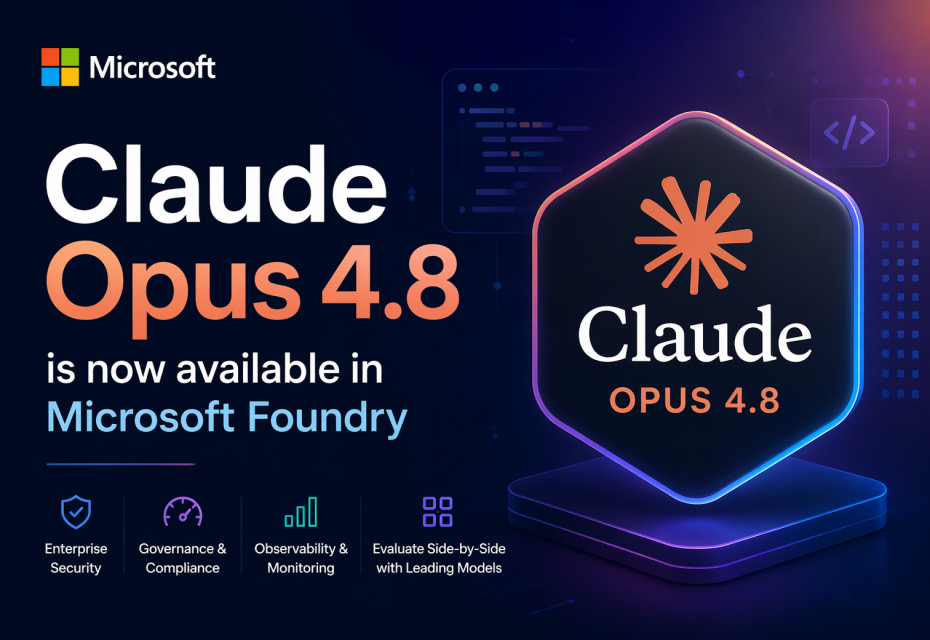
There are a lot of AI model announcements these days, but every now and then one lands that feels immediately practical for real engineering work.
Claude Opus 4.8 showing up in Microsoft Foundry feels like one of those releases.
Microsoft is positioning Claude Opus 4.8 around coding, agentic workflows, and deeper reasoning for enterprise scenarios, while Anthropic describes it as their most intelligent generally available Opus model for coding and agents.
What makes this interesting is not just “the benchmark number went up again.” The more important part is that these newer models are getting better at actual developer workflows:
- reasoning across multiple files
- maintaining context longer
- handling multi-step tasks
- recovering from mistakes
- following structured instructions
- working more reliably in tooling pipelines
That is a pretty different problem space compared to “generate a todo app in one prompt.”
And honestly, that is where most teams are today.
The shift from “AI chatbot” to “AI teammate”
A lot of developers already use AI for small tasks:
- regex generation
- boilerplate APIs
- unit tests
- SQL queries
- debugging weird errors at 2AM
But the new generation of models is moving into a more interesting space: helping with systems-level work.
Think things like:
- reviewing architecture decisions
- planning refactors
- migrating legacy code
- analyzing logs and incident summaries
- understanding large repositories
- generating implementation plans instead of isolated snippets
That is the type of workload Claude Opus 4.8 seems designed for. Microsoft’s Foundry blog specifically calls out longer-running tasks, deeper reasoning, and more reliable tool use for agentic workflows.
And if you are already building internal copilots or AI-assisted engineering workflows, having this available inside Microsoft Foundry means you can evaluate it alongside other models without building ten different integration layers.
Let’s build something real with C# with EntraID
Enough marketing though.
Let’s actually call Claude Opus 4.8 from a .NET console app using the Azure AI Inference SDK.
This is the official SDK Microsoft documents for Azure AI Foundry model inference. It supports chat completions for Foundry-hosted models using ChatCompletionsClient
This sample keeps things simple:
- console app
- DefaultAzureCredential
- BearerTokenPolicy
- no API key
- a realistic prompt that asks Claude to help modernize a messy ASP.NET Core API
Create the project and add your endpoint to environment variables
|
1 2 3 4 5 6 |
dotnet new console -n ClaudeFoundryConsole $ cd ClaudeFoundryConsole $ dotnet add package Azure.AI.Inference --prerelease $ dotnet add package Azure.Identity $ export AZURE_AI_CHAT_ENDPOINT="https://YOUR-ENDPOINT.models.ai.azure.com" $ export AZURE_AI_MODEL="claude-opus-4-8" |
Program.cs
|
1 2 3 4 5 6 7 8 9 10 11 12 13 14 15 16 17 18 19 20 21 22 23 24 25 26 27 28 29 30 31 32 33 34 35 36 37 38 39 40 41 42 43 44 45 46 47 48 49 50 51 52 53 54 55 56 57 58 59 60 61 62 63 64 65 66 67 68 69 70 71 72 |
using Azure.AI.Inference; using Azure.AI.Inference.Models; using Azure.Core.Pipeline; using Azure.Identity; var endpoint = Environment.GetEnvironmentVariable("AZURE_AI_CHAT_ENDPOINT"); var model = Environment.GetEnvironmentVariable("AZURE_AI_MODEL") ?? "claude-opus-4-8"; if (string.IsNullOrWhiteSpace(endpoint)) { Console.WriteLine("Please set AZURE_AI_CHAT_ENDPOINT."); return; } // Entra ID auth using DefaultAzureCredential BearerTokenPolicy tokenPolicy = new( new DefaultAzureCredential(), "https://ai.azure.com/.default"); // Create the client using Azure credentials var client = new ChatCompletionsClient( new Uri(endpoint), new DefaultAzureCredential()); var options = new ChatCompletionsOptions { Model = model, Temperature = 0.2f, MaxTokens = 1800 }; options.Messages.Add(new ChatRequestSystemMessage( """ You are a senior .NET architect. Your job is to help developers modernize real systems without overengineering. Prefer practical and incremental changes over full rewrites. Be specific, opinionated, and implementation-focused. """ )); options.Messages.Add(new ChatRequestUserMessage( """ I have an ASP.NET Core API with: - fat controllers - EF Core queries directly in controllers - duplicated business rules - almost no tests - some services using static helper classes Please help me improve it. Return: 1. a better project structure 2. a sample service interface and implementation 3. DI registration suggestions 4. one realistic unit test example 5. a safe migration plan that avoids a big-bang rewrite """ )); Console.WriteLine($"Calling model: {model}"); Console.WriteLine("Sending request with DefaultAzureCredential..."); Console.WriteLine(); var response = await client.CompleteAsync(options); foreach (var item in response.Value.Content) { Console.WriteLine(item.Text); } |
Final thoughts
Claude Opus 4.8 in Microsoft Foundry looks genuinely interesting for developers because it is not only being framed as a better model — it is being framed as a better model for the kind of work developers actually do:
- coding with context
- multi-step problem solving
- architecture-aware suggestions
- agentic workflows
- professional and enterprise reasoning
That is a much better story than “new model, now with extra adjectives.”
If your team already lives in Azure, already experiments with coding assistants, or is building internal AI tooling, this is definitely one worth trying.
Resources
Claude Opus 4.8 is now available in Microsoft Foundry Blog
Model Card

Leave A Comment